
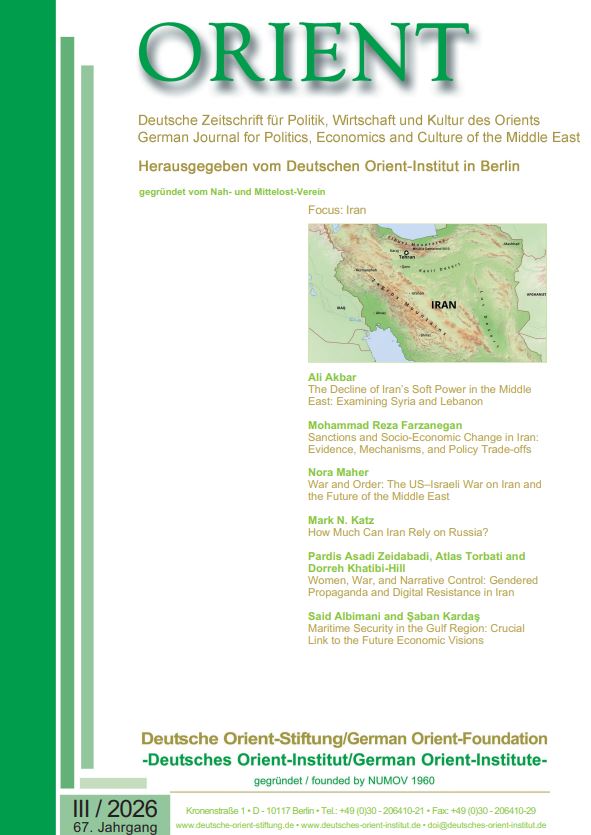
Please access this edition of our quarterly journal through the ORIENT website
Few countries in the Middle East have shaped the region’s conflicts and power struggles as persistently as Iran. This edition
of ORIENT turns to Iran not only as an actor in conflict, but also as a regional power being tested on multiple fronts. In “The Decline of Iran’s Soft Power in the Middle East: Examining Syria and Lebanon”, Ali Akbar analyses the erosion of Iran’s influence through the cases of Syria and Lebanon, two countries central to Tehran’s strategic reach. Mohammad Reza Farzanegan’s article “Sanctions and Socio-Economic Change in Iran: Evidence, Mechanisms, and Policy Trade-offs” examines the socio-economic consequences of sanctions and questions their political effectiveness. Nora Maher’s article “War and Order: The US–Israeli War on Iran and the Future of the Middle East” situates the current conflict within broader transformations of Middle Eastern order and assesses Iran’s strategic responses. Mark N. Katz, in “How Much Can Iran Rely on Russia?” explores the limits of Russian support for Iran and its regional allies, raising questions about the durability and reliability of this partnership. Pardis
Asadi Zeidabadi, Atlas Torbati, and Dorreh KhatibiHill contribute “Women, War, and Narrative Control: Gendered Propaganda and Digital Resistance in Iran”, which examines how the Islamic Republic selectively mobilises images of women, while diasporic communities contest these state narratives. Lastly, Said Albimani and Şaban Kardaş’s article “Maritime Security in the Gulf region: Crucial Link to the Future economic Visions” examines the importance of maritime stability for the Gulf states development plans, showing how insecurity threatens diversification, and regional security. Taken together, the contributions in this issue approach Iran as a central yet increasingly pressured actor in a changing regional order. Rather than offering a single interpretation, this edition of ORIENT brings together perspectives that illuminate the complexity of Iran’s present and the uncertainties that will continue to define its role in the region.